Start with the print. Clean it, smooth what you want to be smooth, and seal porous spots if the plastic would drink the bath. The metal will copy whatever texture is left.
About 3 minutes for the basic explanation
learn
What Is Electroplating?
How electricity transforms dissolved metal into a real, solid coating — and how that same process can turn an ordinary 3D print into copper.
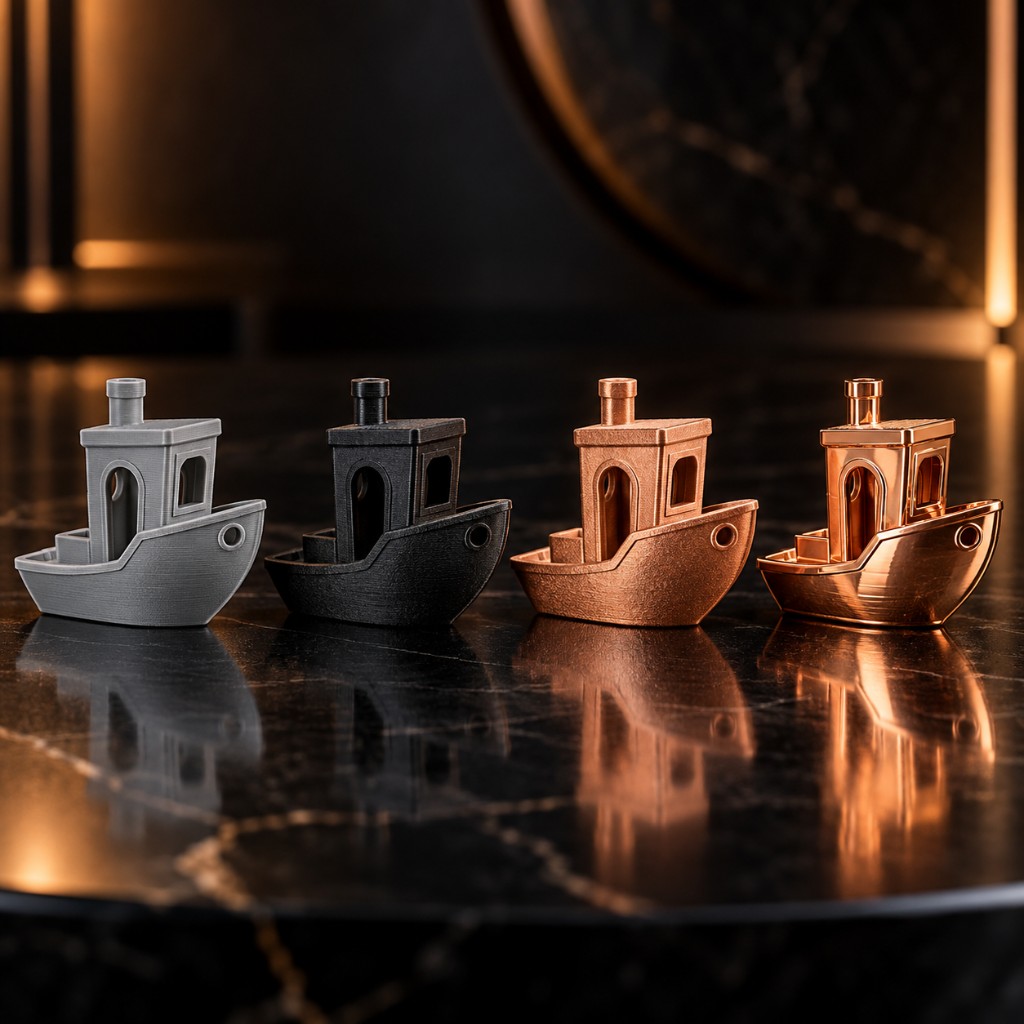
Print. This boat is gray plastic. Plastic holds the shape, and it does not carry electricity.
Paint. A black conductive coat covers the plastic. That coat is what lets electrons reach the surface.
Plate. Real copper has grown on the paint. It is metal, and it is still matte.
Polish. The copper was already there. Buffing makes the same metal reflective.
Imagine taking something made entirely of plastic and coating it with actual copper metal.
Not copper-colored paint. Not metallic-looking plastic. Real copper, deposited onto an object's surface using electricity.
This process is called electroplating, and versions of the technology have been used in manufacturing for nearly two centuries.
Let's explore how it works.
Growing Metal With Electricity
Electroplating uses electrical energy to deposit a layer of metal onto another object's surface. Nothing is melted and poured. The copper starts out dissolved.
Those dissolved pieces are copper ions, in a liquid called an electrolyte. Connect a conductive object to the negative side of a DC power supply, put it in that liquid, and the ions can pick up electrons at the surface and become solid copper. The atoms pile up into a coating.
Copper starts out dissolved in the blue liquid, and electricity allows those copper ions to become solid metal on a conductive surface.
The plating tank
The bath is a clear blue. You should be able to see the painted part and the copper sheet through it. Pick a label to read what that part does.
Cathode. The painted benchy is connected to the negative terminal. Copper ions meet electrons here and become metal.
Anode. The copper sheet is connected to the positive terminal. Copper from the sheet replaces copper that leaves the bath, so the blue solution is not used up all at once.
Electrolyte. This is the blue liquid. It holds the dissolved copper. It is not paint, and it is not molten metal.
Power supply. A DC source. Electrons travel in the wires, from the positive side's circuit to the negative object. The PrintPlating USB supply is one kind of DC source. It is not an adjustable lab rectifier.
Copper ions. Cu²⁺ pieces scattered in the liquid. They drift toward the negative part. They do not march in a straight line from the sheet to the boat.
How Does Electricity Turn Blue Liquid Into Copper Metal?
Copper in the bath carries a positive charge. At the negative surface it can gain two electrons and become a neutral copper atom. That atom joins the metal coating. This gain of electrons is called reduction.
Cu²⁺ + 2e⁻ → Cu
Dissolved copper. The blue field is the electrolyte. Each dark blue dot is a Cu²⁺ ion, spread through the liquid rather than lined up.
Reaching the surface. Ions wander toward the negative part. The dashed guides are curved on purpose. Real ions do not fly in a straight shot from anode to cathode.
Electron transfer. Zoomed in: one copper ion meets two electrons at the cathode. Cu²⁺ + 2e⁻ → Cu.
Copper deposition. The ion is now a neutral copper atom, sitting in the metal that is already there.
Building the coating. Many of those events make a continuous copper layer. Some ions are still in the bath. The plastic under the black paint never turned into metal.
Explore the Chemistry
At the cathode, reduction: Cu²⁺(aq) + 2e⁻ → Cu(s). The ion gains two electrons and becomes solid copper.
At the anode, oxidation: Cu(s) → Cu²⁺(aq) + 2e⁻. Copper metal from the sheet becomes ions and releases two electrons.
Electrons travel through the external wires. They do not swim across the bath. In the liquid, charged ions carry the current: positive copper ions move toward the cathode, and negative ions move toward the anode.
The copper anode is the refill for the bath. As copper plates onto the part, copper from the sheet dissolves, which is why a copper sheet is hung in the same solution.
Plastic Doesn't Conduct Electricity. So How Can You Plate It?
Ordinary 3D-printing plastics are insulators. They cannot take a conventional copper plate by themselves. Conductive paint adds a thin skin of graphite and carbon. Connect that skin to the negative terminal and electrons can reach the surface, where copper ions are reduced to metal. The copper builds on the paint. The object underneath is still plastic.
Before. Gray plastic, then a dark paint film. The specks are conductive particles touching one another so current has a path. No copper yet.
After. Copper sits on the paint, not instead of the plastic. Miss a patch of paint and that patch stays bare, because ions only become metal where the surface can take the charge.
Plating copies the surface under it. A rough print stays rough under the metal. A gap in the paint stays plastic. Porous prints need to be sealed enough that the bath does not soak in. The coat also has to be dry and hooked up to the wire.
Why Is the Liquid Blue?
Copper sulfate dissolves in water and releases copper ions. Each ion is surrounded by water molecules. That hydrated copper(II) ion absorbs some colors of visible light and lets blue through, so the bath looks blue.
The copper on your part comes from those dissolved ions. Not every copper plating bath is this chemistry, and not every copper bath is this same blue.
Why blue?
Hydrated copper(II) ions have an electron arrangement that absorbs longer visible wavelengths. What remains for the eye is blue. The color is a property of the dissolved ion, not a dye added to the water.
Four Stages From Plastic to Metal
Brush on a continuous coat and let it dry. The starter guide uses two thin coats, with 12–24 hours of drying for each coat. The part needs an electrical connection to the wire.
Hang the part in the blue bath. Copper sheets go to the positive side. The painted part goes to the negative side. Ions gain electrons at the surface and become metal.
Rinse, dry, and finish carefully. Polishing can turn matte copper reflective. The result depends on prep, coverage, the bath, the electrical setup, time, and how you finish it.
More Than 200 Years of Electroplating
People stuck gold onto objects long before electricity, with leaf and with older gilding methods. Electroplating is the version that uses current. Electroforming is a cousin, not the same job: forming grows a metal part that is later freed from its mold, while plating leaves a coating on the object.
1800. Alessandro Volta's pile, a stack of metal discs, gave experimenters a steady current. Electrochemistry needed that current before anyone could plate with it.
1805. Luigi Brugnatelli used Volta's pile to deposit gold onto silver. It is the early demonstration people point to. It did not yet become a factory trade, and it was not the ancient craft of gilding.
1830s–1840s. George Richards Elkington and Henry Elkington, in Birmingham, turned electroplating into a business. Their 1840 patent sits in the middle of that commercial start. Silver-plated tableware is why the word entered ordinary homes. Those gold and silver baths were a different chemistry from this copper kit.
Late 1800s through the 1900s. The same idea spread into decorative metal, corrosion coatings, and electrical parts. Plastic joined in only after a conductive coating could give it a surface that carries current.
Today. Electronics, jewelry, cars, hardware, and printed props all use versions of it. A plated benchy is the workshop-scale cousin of those factory coatings.
You've Probably Used Electroplated Products Today
Copper plating builds conductive paths in multilayer boards, including the plated holes that connect one layer to another.
More
A via is a hole through the board. Plating that hole with copper joins the copper layers electrically. That is a manufacturing use of the same ion-to-metal step.
Gold, silver, rhodium, and other plated finishes change color and surface behavior without making the whole piece out of that metal.
More
The precious metal is a skin. What is underneath carries the shape. Those baths are not the copper sulfate bath in this kit.
Gold, nickel, and tin plates help contacts carry current and resist corrosion.
More
The gold you see on a connector is thin on purpose. It stays put where two parts touch, instead of making the whole pin out of gold.
Layered metal coats decorative trim, brightwork, and some plastic parts that were prepared to take a plate.
More
A common decorative stack puts copper down first, then other metals. The copper is the metal surface the later layers need. Plastic trim needs a conductive coat before any of that.
Zinc electroplating protects many steel screws and fittings from rust.
More
Not every zinc-coated or galvanized part was electroplated. Hot-dip galvanizing dips steel in molten zinc. That is a different process with a similar goal.
A conductive coat lets a prepared print take copper, so a complicated plastic shape can wear a real metal surface.
More
That is the job of the PrintPlating kit: the copper step on prints, props, and small parts. Later metals are a different bath.
Explore the Same Science in Your Own Workshop
The science is the same in a factory and at a bench. The bench still needs the right gear, a compatible bath, a prepared surface, solid electrical connections, and careful handling of the chemicals. Prep is the part that stops most first attempts.
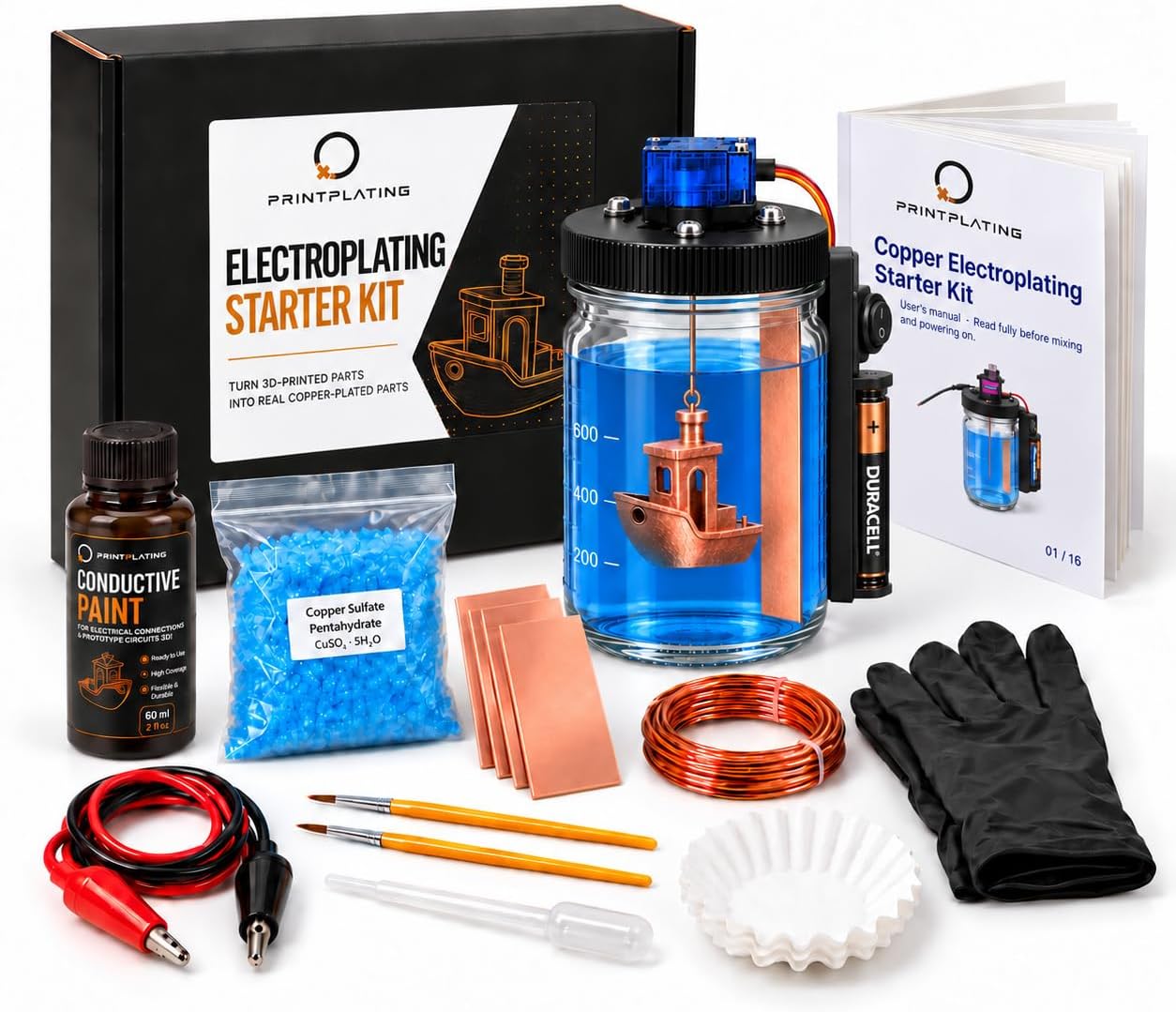
In the starter kit: conductive paint, copper sulfate, copper anodes, wire, plating jar, gloves, brushes, and the starter guide.
You supply: distilled water, battery acid, safety glasses, a polishing tool, and — for the $127 kit — a compatible DC power supply. Each one does a job the kit cannot do for you.
Distilled water is what the copper sulfate dissolves in. Minerals in tap water get into the bath and show up in the plate.
Battery acid is about 30–35% sulfuric acid, the automotive electrolyte named in the starter guide. It lets the dissolved copper move when the current is on. The mixing card in the kit uses 67 mL (85 g) for the jar. Add the acid into the water. Never add water into the acid.
Safety glasses are for the acid and the bath. Gloves are already in the kit. Glasses are not.
A polishing tool is how matte copper becomes bright. Fresh copper looks dull until a rotary tool with a wire brush and a polishing bit works the surface. That tool is not in the kit.
A DC power supply is the current. The $127 kit does not include one. The $168 bundle adds a USB power supply and a USB female extension cable. That supply is not an adjustable lab rectifier. Distilled water and the acid are still separate either way. Batteries are not included.
$149$127
Not a toy. Wear glasses, ventilate, and do not pour the bath down a household drain. Safety notes · SDS.
Questions
Is electroplated copper real metal?
Yes. The coating is genuine metallic copper, deposited atom by atom from ions.
Does the entire 3D print become metal?
No. The plastic stays inside. You have a plastic part wearing a copper shell.
Is electroplating just metallic spray paint?
No. Spray paint is a coating of pigment. Electroplating uses electricity to turn dissolved ions into solid metal.
Why do I need conductive paint?
Plastic does not give electrons a path. The paint does. Without that path, copper ions in the bath have nowhere to become metal.
How thick is the copper coating?
It depends on time, current, the surface area, and how efficiently the bath is working. There is no single thickness for every part.
Can any 3D print be plated?
No. Material, shape, sealing, surface prep, and whether the paint stays stuck all decide if it works.
Is electroplating dangerous?
It uses electricity and chemicals. It needs eye protection, ventilation, careful storage, and a real disposal plan. Read the safety page and the SDS before you mix anything.
Can other metals be electroplated?
Yes. Nickel, silver, gold, and others each need their own bath, equipment, and safety rules. They plate onto copper more readily than onto the paint. This kit is the copper step.
Now That You Know How It Works, Try It Yourself.
Copper starts out dissolved in the blue liquid, and electricity allows those copper ions to become solid metal on a conductive surface. The same steps can put that shell on your own prints.