How to Choose Conductive Paint for Electroplating Plastic and 3D Prints
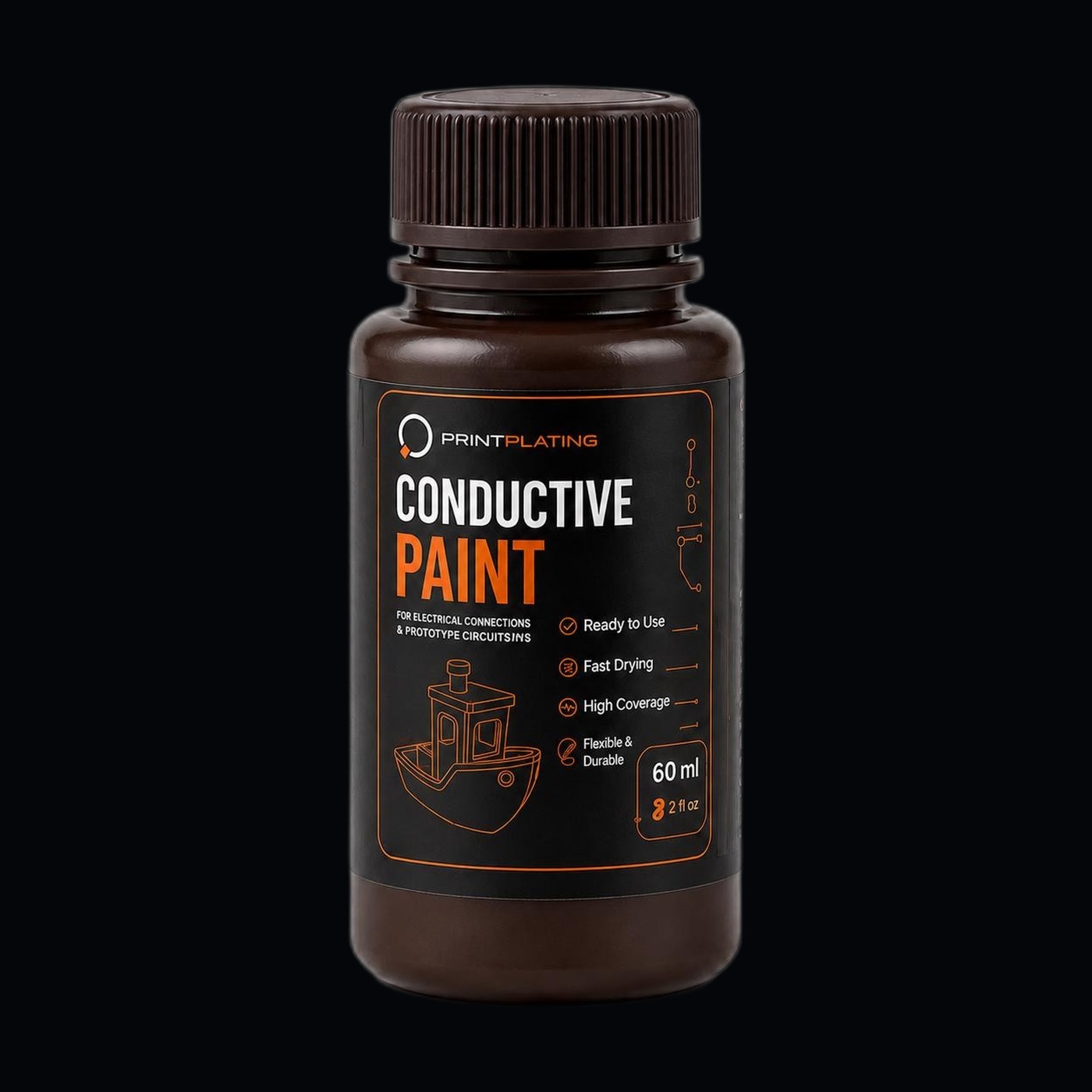
Ordinary PLA, PETG and resin cannot act as a reliable cathode on their own. A conductive coating connects the surface to the electrical supply so copper can grow across it. Choose a coating explicitly intended for your plating chemistry, not merely a paint that looks metallic. PrintPlating sells a brush-applied conductive paint intended for copper electroplating. This guide helps you decide whether paint alone is the right purchase or whether you need a full kit.
Which type of conductive coating should you buy?
| Coating | Why choose it | What to verify |
|---|---|---|
| Carbon or graphite coating | Often a practical brush-on starting layer | Conductivity after drying, adhesion and compatibility with the bath |
| Copper-filled coating | Can be a useful starting layer for copper deposition | Binder, oxidation, coverage and the supplier’s intended electrolyte |
| Silver-filled coating | Can be useful when a supplier specifies a high-conductivity coating | Cost, adhesion and exact compatible process |
| Metallic decorative spray paint | Provides a metal-like color | Usually not specified as an electroplating conductor; do not assume it works |
The coating label is not a performance test. The binder, particle distribution, drying, film thickness and surface preparation can matter as much as the filler. TIFOO describes copper and silver coatings for specific plating processes; Prusa reports experimenting with copper, graphite and silver products and encountering variable results. Neither source is a head-to-head test of PrintPlating paint.
Test a coating before buying a larger quantity
Print a small coupon with the same polymer, surface finish and primer as your project. Prepare it as you would the final part. Apply thin, even coats using the coating instructions, allow full drying, then check the film for lifted edges, missed corners and visible clumps. A smooth, intact coating is more useful than a thick layer that feels dry on the outside but remains soft underneath.
Use a multimeter on the dry, disconnected coupon. Record resistance from the intended wire-contact point to three or more remote points, including a recess and a corner. Touch the probes together first to understand lead resistance. Keep probe pressure and positions consistent. Repeat after repairing questionable coverage. A continuity beep alone is not a quantitative measure of the entire surface. There is no universal ohm threshold for every formulation and geometry; follow the coating and kit instructions, and investigate unstable or open readings before proceeding.
A simple repeatable comparison
For two coatings, use identical coupons and the same preparation. Log the number of coats, drying time, observed resistance range, adhesion and coverage after a small supervised plating trial under the appropriate instructions. Use separate compatible setups if their chemistry differs. Compare only like-for-like results; do not rank one product from a single successful coupon. This experiment is a suggested evaluation method, not a claim of measured PrintPlating performance.
How much conductive paint do you need?
Estimate total painted area from your CAD model or a simplified geometry. Include every face and recess you intend to plate. The useful planning formula is area × planned coats ÷ supplier-stated coverage per unit volume, plus measured application losses. If no coverage figure is specified, measure the volume used on a representative coupon instead of guessing.
For example, if a test coupon of 25 cm² consumes 2 mL for the complete coat schedule, a 150 cm² part would scale to about 12 mL under the same conditions. Complex geometry may need extra material. This is an illustrative calculation, not our product's verified coverage. Check the live listing for actual pack size; do not confuse bottle capacity with usable coating volume.
Diagnose failures before buying another bottle
| Observation | Check first |
|---|---|
| Copper grows on wire but not the part | Contact between wire and the dry conductive surface |
| Bare recesses | Coverage and continuity to the most distant point |
| Paint wrinkles or lifts | Preparation, full drying and chemistry compatibility |
| Rough, dark copper | Pause safely and check bath/current guidance, not just paint |
The substrate is part of the coating system. A poor primer or a contaminated surface can make an otherwise suitable paint fail. Check the PLA, PETG and resin preparation guide before changing products. Never improvise a thinner or additive: follow the exact label and SDS for the coating you bought.
Buy paint alone or a starter kit?
If you already have a compatible electrolyte, anodes, a safe tank and power source, buying only conductive paint may be sufficient. If you are starting from scratch, compare the complete kit configurations so the coating and copper process are selected together. For other consumables, see the refill and anode guide.
Common buying questions
Can I use conductive filament instead of paint? Some filled filaments conduct, but their surface may not provide a uniform path for plating. Test the actual surface and follow the chosen system’s instructions.
Is copper paint the same thing as a copper coating? No. The prepared paint film is the starting conductor; the metal layer grows during electrodeposition.
Can I plate immediately when the paint feels dry? No. Follow its full drying requirements and confirm continuity. A thick film can retain solvent or moisture.
Can I reuse the same paint for other metals? Only where the supplier documents a compatible process. The PrintPlating starter system is intended for copper.
References and further reading
- PrintPlating Starter Kit Guide, pp. 3–16 (supplied with the kit); see our electroplating overview, safety guide and safety data sheets.
- Prusa: electroplating 3D prints and conductive paint experiments.
- TIFOO: conductive coatings and their specified uses.
Shop conductive paint · Compare complete kits
Copper electroplating buying guides
Choose the guide that matches the equipment or project you are planning.
- Electroplating kits for 3D prints — Choose a complete beginner setup; compare what is included, fit and the supplies you still need.
- Metal 3D printing vs. copper electroplating — Compare finished appearance, total process cost, material properties and manufacturing routes.
- PrintPlating vs. Caswell and other options — Compare the jar system, larger rectifier kit and component-based approaches without misleading price claims.
- Electroplating PLA, PETG and resin prints — Choose a substrate and identify preparation, sealing and adhesion requirements.
- Choosing an electroplating power supply — Understand area, current control, compatible supplies and safe test checks.
- Copper electroplating chemicals and supplies — Choose copper sulfate refills, anodes, paint and bath accessories using a replenishment checklist.
- Electroplating cosplay props, models and jewelry — Decide which projects suit a copper finish and design parts that fit the bath.