Metal 3D Printing vs. Electroplating: Which Is Right for Your Part?
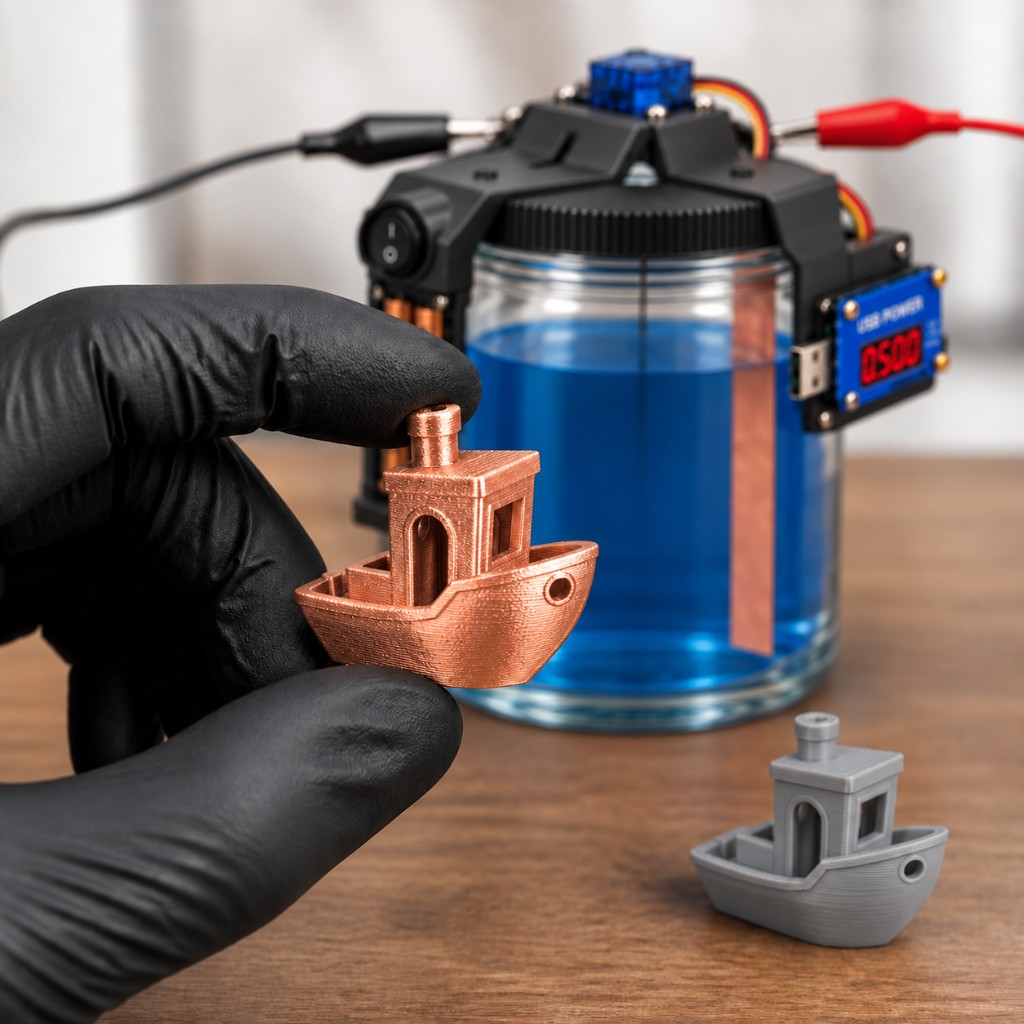
If you want a real metallic surface on a conventional 3D print, copper electroplating may be an accessible alternative to ordering a solid metal part. If you need a load-bearing metal component, high-temperature service or certified material properties, it is not an interchangeable substitute. Choose the manufacturing route for the job the part must perform, not just how the finished part looks.
Four routes to a metallic-looking part
| Route | Finished construction | Best candidate | Major limitation |
|---|---|---|---|
| Electroplate a polymer print | Metal coating over polymer | Decorative prototypes, models and props | Substrate, adhesion and coating thickness still govern performance |
| Direct metal additive manufacturing | Metal part made by a metal printing process | Complex functional metal geometry | Specialized process, finishing and qualification costs |
| Investment casting from a printed pattern | Cast metal after pattern removal | Solid metal shapes suitable for a casting process | Pattern, mold, alloy and finishing constraints |
| Metallic paint | Decorative pigmented film | Color and appearance without plating equipment | Not a deposited continuous metal layer |
These are different processes, not four identical outcomes. A printed prototype can be coated in real copper without purchasing a metal printer, but a shiny surface does not establish structural strength, conductivity, heat resistance or a certification.
When copper-coated plastic is a good fit
Use it when the core can remain polymer and the finish itself is a design requirement. A small display piece may benefit from the look and polish of copper while keeping the convenience of a desktop print. A model with replaceable decorative components can be prepared and plated as separate sections. If your project requires a specific metal, check whether your process deposits that metal or only provides an intermediate copper layer.
Formlabs documents a professional project in which resin-printed automotive concept hubcaps received a nickel coating. It demonstrates the hybrid manufacturing approach, not an equivalence between hobby copper kits and that professionally controlled process. Do not transfer published results for professional multilayer coatings to a DIY coating without testing.
Compare the actual cost of one finished part
Include the full route, not just the price of a machine or kit. The cost per accepted part depends on the number of acceptable parts, material, preparation, supervision, failure rate and disposal. For an outsourced metal part, get a quote for your actual CAD file, alloy, finishing and inspection. For home copper plating, include the kit, additional items, consumables and your own time.
For a simple budgeting example, suppose a workshop buys equipment for $180, spends $8 in material per attempted part and makes 12 attempts that produce 10 acceptable decorative parts. Equipment and materials total $276, or $27.60 per accepted part before labor, shipping, disposal and taxes. With only one acceptable part the equipment cost cannot be spread across many projects. This is a hypothetical scenario, not a PrintPlating quote or a measured yield. Use your own numbers and compare with a current vendor quote.
What does the metal layer actually add?
A coating changes the outside dimensions. For a uniform coating with thickness t on both sides of a shaft, its diameter increases by approximately 2t. Real plating is not perfectly uniform, especially around edges and recesses. Design clearance for the intended coating and finishing; measure representative features rather than relying on the nominal CAD dimension. The polymer still responds to loads and heat, and the layer can crack or separate if the substrate deforms.
Do not use an unqualified plated polymer part as a pressure vessel, electrical safety conductor, food-contact surface, medical device, structural fastener or high-temperature component. Consult appropriate engineering requirements and qualified suppliers for those applications.
Decision checklist before buying
- Does the part need bulk metal properties, or is a real metal finish enough?
- Will the part fit a chemical-safe tank with clearance for the anodes and fixture?
- Can you clean, dry, seal and conductively coat all intended surfaces?
- Are dimensional tolerances loose enough for coating and finishing, or do you need verified thickness control?
- Can you safely manage the chemistry, waste and supervised workshop time?
If a project fails the first or fourth question because it requires a qualified metal component, seek a suitable metal manufacturing service instead of assuming plating will solve it. If all you need is a durable-looking copper finish for a decorative prototype, compare the starter kit buying guide. Larger or difficult projects can be discussed through our plating service or quote request.
Frequently asked questions
Does electroplating make a print solid metal? No. It deposits a layer onto the prepared outside surface. Removing a core to make a separate metal shell is electroforming and requires different validation.
Is electroplating always cheaper than metal printing? No. Compare actual finished-part quotations and expected yield; labor can dominate a complex plated project.
Can I obtain a mirror finish? The finish depends on preparation, deposition and polishing. The bath does not erase deep defects.
What should I buy for a first trial? A suitable small copper kit, a compatible power source if not included, the separately listed preparation and protective supplies, and a representative practice print.
References
- PrintPlating Starter Kit Guide, pp. 3–16 (supplied with the kit); see our electroplating overview, safety guide and safety data sheets.
- Formlabs: professionally electroplated concept vehicle hubcaps.
- Formlabs: metal coating in post-processing.
Compare starter kits · See our plating service
Copper electroplating buying guides
Choose the guide that matches the equipment or project you are planning.
- Electroplating kits for 3D prints — Choose a complete beginner setup; compare what is included, fit and the supplies you still need.
- Conductive paint for electroplating plastic — Choose and test a coating before you commit your print to the copper bath.
- PrintPlating vs. Caswell and other options — Compare the jar system, larger rectifier kit and component-based approaches without misleading price claims.
- Electroplating PLA, PETG and resin prints — Choose a substrate and identify preparation, sealing and adhesion requirements.
- Choosing an electroplating power supply — Understand area, current control, compatible supplies and safe test checks.
- Copper electroplating chemicals and supplies — Choose copper sulfate refills, anodes, paint and bath accessories using a replenishment checklist.
- Electroplating cosplay props, models and jewelry — Decide which projects suit a copper finish and design parts that fit the bath.