PrintPlating vs. Caswell: Copper Electroplating Kits and Alternatives
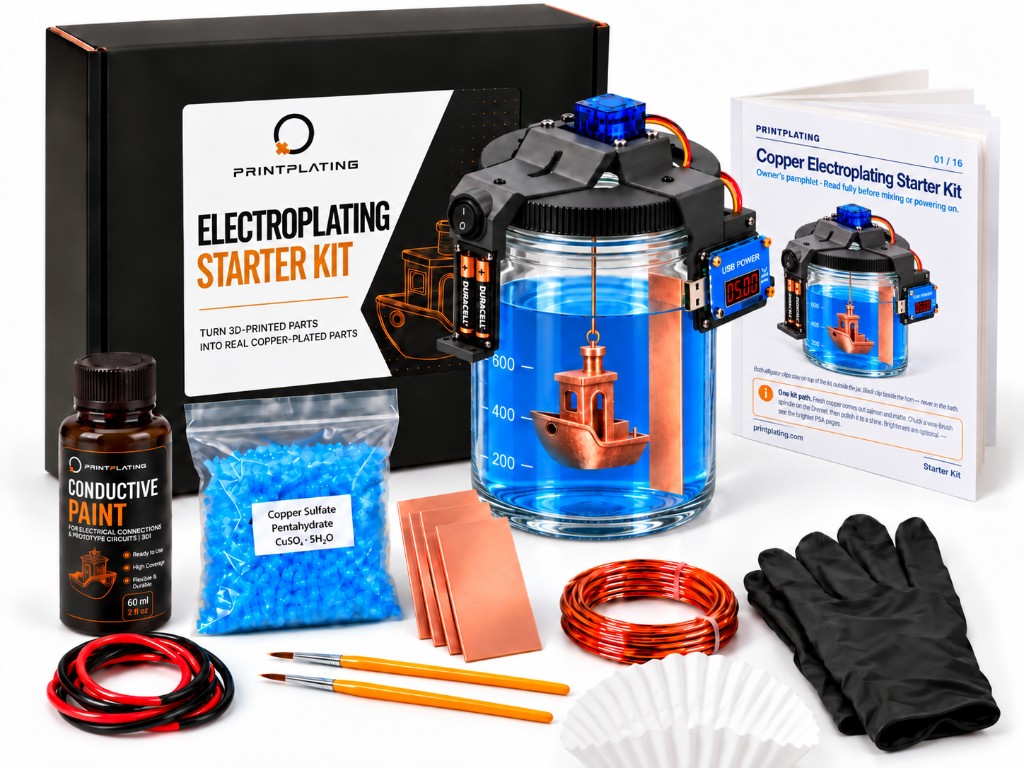
Choosing between PrintPlating and Caswell comes down to the size of your parts, the equipment you already own and the level of control your project needs. PrintPlating offers a small jar-based copper system in two configurations. Caswell lists a larger tank-based kit with an included rectifier. Neither is automatically the better buy for every project. This comparison is written by PrintPlating, which sells its own kits; it is a specification-based guide, not an independent performance ranking.
Compare the kits by what is actually included
| Specification | PrintPlating standard | PrintPlating with supply | Caswell 3D Printed Parts Plating Kit |
|---|---|---|---|
| Current price | Check listing | Check listing | Check listing |
| Power | User supplies compatible DC source | USB supply and female extension included | 5 A rectifier listed |
| Bath | Starter jar | Starter jar | 1 US gallon tank, ¾ US gallon of prepared copper chemistry listed |
| Starting coating | Conductive paint | Conductive paint | Graphite coating listed |
| Metal and chemistry | Copper system | Copper system | Copper crystals, additives and anodes |
| Other items | Follow kit packing list and separately required materials | Same, except power configuration | Check manufacturer's required materials and optional rinse equipment |
Specification sources are the current PrintPlating storefront and Caswell's official 3D Printed Parts Plating Kit listing, reviewed November 25, 2026. Caswell lists additional plating metal options separately. Its own advertised current or area rating applies to its system; it is not a transferable maximum part-size guarantee. Check prices at checkout, including tax, shipping, currency and any separately needed items. No time-limited discounts are assumed here.
When each configuration is worth considering
PrintPlating standard: If you already have a compatible supply and a small project that fits the jar with anode clearance, this avoids purchasing a duplicate supply. Verify that the supply meets the kit’s guidance for your part. Buying a lower-price kit and then replacing unsuitable power hardware can negate the savings.
PrintPlating with power supply: If you want the included USB configuration for an intended small hobby project, this simplifies the purchasing checklist. It does not imply adjustable constant-current control, nor a universal current rating. For a larger or demanding geometry, determine the required control and capacity before purchase.
Caswell: Consider this larger setup when its tank dimensions and included 5 A rectifier meet your project requirements. The larger bath may also mean purchasing, handling and ultimately disposing of more chemistry. Confirm the usable immersion dimensions with fixtures and anodes installed, not just the tank volume.
Component-based system: If you already have a compatible tank, controlled DC supply and chemistry, purchasing a matched coating and consumables may be more efficient than a full package. TIFOO publishes guidance for its own conductive coatings and compatible electrolytes. This can be useful for comparing a modular approach, but do not combine products across systems unless the manufacturers document compatibility.
Calculate the complete setup cost
Create a shopping list with separate columns for base kit, missing power supply, chemical-safe tank and fixtures, specified electrolyte ingredients, protective equipment, cleaning/preparation, finishing, rinse containers, waste handling and delivery. Add only items you genuinely lack. The cheapest starting kit can be the wrong value if it cannot fit the intended part or requires extra equipment. Conversely, paying for a larger bath or rectifier you will never use can be unnecessary.
Example: If option A costs $X and requires $Y of missing equipment, while option B includes that equipment, compare X + Y with B's total at checkout. If you already own those items, Y may be zero. Use actual prices from the links above rather than assuming the former promotional price will remain available.
Compare the evidence, not promises
A vendor photo tells you what a finish may look like, not its expected success rate. A useful comparison uses identical printed coupons, equivalent preparation, the manufacturer-specific bath instructions and documented acceptance criteria. Record appearance, coating adhesion, coverage of remote details and repeatability. We have not conducted a controlled comparison between PrintPlating, Caswell and TIFOO, and make no claim that one delivers a superior coating.
Questions before you order
Can I use Caswell's mixing instructions for PrintPlating? No. Use the exact mixing card and SDS for the chemical system you purchased.
Does either kit eliminate the need for surface preparation? No. Preparation, drying and electrical contact are still essential when plating insulating plastics.
Can I add nickel or gold later? Only with a documented compatible process and the appropriate additional equipment and safety controls. The core PrintPlating system is for copper.
What if the part does not fit the starter jar? Evaluate a larger documented system or a suitable plating service; do not force a crowded fixture into a small tank.
Sources and next steps
- Caswell official kit specifications.
- TIFOO conductive coating guide.
- PrintPlating Starter Kit Guide, pp. 3–16 (supplied with the kit); see our electroplating overview, safety guide and safety data sheets.
New to copper plating? Read our 3D print electroplating kit buying guide, then compare the standard kit and kit with power supply. Caswell and TIFOO are independent brands; PrintPlating is not affiliated with them.
Copper electroplating buying guides
Choose the guide that matches the equipment or project you are planning.
- Electroplating kits for 3D prints — Choose a complete beginner setup; compare what is included, fit and the supplies you still need.
- Conductive paint for electroplating plastic — Choose and test a coating before you commit your print to the copper bath.
- Metal 3D printing vs. copper electroplating — Compare finished appearance, total process cost, material properties and manufacturing routes.
- Electroplating PLA, PETG and resin prints — Choose a substrate and identify preparation, sealing and adhesion requirements.
- Choosing an electroplating power supply — Understand area, current control, compatible supplies and safe test checks.
- Copper electroplating chemicals and supplies — Choose copper sulfate refills, anodes, paint and bath accessories using a replenishment checklist.
- Electroplating cosplay props, models and jewelry — Decide which projects suit a copper finish and design parts that fit the bath.